Friday, October 2, 2020

Mother pulls her child out of school over flat-Earth conspiracy theory

mother child flat-earth theory

A US woman believing in the flat-Earth conspiracy theory took her child out of school just because the kid was taught that the Earth is round instead of flat as she believes. 

In a Facebook post, she said she was disturbed to learn that her 10-year-old had been taught that the Earth was round. The parent said she firmly believes the Earth is in fact flat, and was upset that the school was teaching her otherwise.

“Is anyone teaching their kids flat Earth?” she asked in the post. “I finally pulled my 10-year-old out of school but the indoctrination has been done.

Rad More: Believing earth is flat, couple sails to see edge of world and then this happened!

“She’s a great critical thinking BUT I notice a few things she’s 100 per cent set on, and round Earth is one!

“I can’t even explain it [to] myself, to my husband. I send him memes but he doesn’t believe either.

“Although he has the bible memorised so that may help me.”

Her controversial views have been criticised by many on social media. A social media user termed her decision to take her child out of school over the conspiracy theory a form of “child abuse”.

A Reddit user disgusted at the post commented: “This makes me sick to my stomach.”

The post Mother pulls her child out of school over flat-Earth conspiracy theory appeared first on ARY NEWS.


from ARY NEWS https://ift.tt/3jrOhI8

Thursday, October 1, 2020

Govt offers Rs30b soft loans for job creation

The provincial government has launched a Rs30 billion Punjab Rozgar Scheme under which soft loans will be offered to generate employment.

Chief Minister Sardar Usman Buzdar inaugurated the scheme at a ceremony held on Thursday.

Addressing the event, the chief minister highlighted that around 1.6 million people would benefit from the scheme. The Pakistan Tehreek-e-Insaf (PTI) government had started taking practical steps to fulfil the promise of providing employment to people, he said.

“The scheme will make youth self-reliant and job providers. Youth will be provided loans on a priority basis and owners of small and medium enterprises (SMEs), as well as those economically suffering because of coronavirus would be able to resume economic activities.”

Buzdar announced that loans of Rs100,000 to Rs10 million would be given at minimal interest rates in collaboration with the Punjab Small Industries Corporation (PSIC) and the Bank of Punjab. Men, women, differently-abled people and transgender community members between 20 and 50 years of age would benefit from the scheme, he said.

Small loans will be provided for 339 sub-sectors of 23 sectors, including 26 sub-sectors of the textile industry, to boost business, trade and manufacturing in the province, he pointed out and added that the initiative would strengthen the cottage industry. He said people could also expand their businesses through the Punjab Rozgar Scheme.

The chief minister maintained the loan process had been made easy and the interested youth could submit their applications through the PSIC and Punjab Bank websites or Punjab Rozgar App.

He said the PTI was committed to making the youth economically self-reliant and the government was enabling them as job providers instead of job seekers. The government was transforming skills as an investment as it was the biggest social asset to make the youth prosperous, he further said.

Provincial Minister Mian Aslam Iqbal said previous rulers wasted billions of rupees on showcase projects, like metro train. The welfare of the poor was badly ignored as past rulers spent a whopping Rs250 billion on the Orange Line metro train but did not give a penny to the needy skilled workers, he alleged. Had this money been spent on giving skills training to the poor children, the country would have been different today, he said and claimed that welfare of common people was not the agenda of the previous government.

He said a project like metro transport did not help the poor earn a living as such projects were started for the sake of kickbacks and political gimmickry. The minister asserted that practical steps had been taken to expedite industrial development and the government was working for the betterment of the poor.

Finance Minister Hashim Jawan Bakht termed the youth as an asset and announced that they would be empowered to strengthen the national economy. “This scheme will be reviewed every month to make it better.”

He announced that banks would be motivated to give loans to the housing sector and hoped that the scheme would prove to be a game-changing initiative.

The PSIC managing director said a target of giving loans to 68,000 SMEs had been set. He highlighted that the soft loans would be given to educated and skilled youth on a priority basis. University graduates, skilled persons from the technical education and vocational training sector and artesian can get benefit from the scheme.

The processing fee of an application will be Rs2,000 and the time period for sanctioning of loan by the bank will not be more than 20 days. The tenure of loan will be from two to five years, including a six-month grace period. The scheme is aimed to give priority to the rehabilitation of the businesses affected by the Covid-19 pandemic. An online portal has also been created with the help of the Punjab Information Technology Board.

Published in The Express Tribune, October 2nd, 2020.


from Punjab News Updates and Insights - The Express Tribune https://ift.tt/2Gqex7d

Arbitrary punishments do not ensure discipline

Black’s Law Dictionary defines arbitrariness in punishment as “when punishment is left to a judge to make a decision as opposed to being prescribed by statute.”

This arbitrariness has been often complained about by subordinates in police department. Aziz Khan, a former DSP who is currently practicing as a lawyer, has written several articles about the issue. He has also described the internal scenarios of orderly rooms of senior police officers. Khan says that the mechanism of punishments in the police is so arbitrary that the punishments vary according to the mood of an officer. If the officer’s mood is good, the subordinate is either spared or given a minor punishment. If his mood is bad, the punishment is severe along with humiliation.

This arbitrariness has served no purpose when it comes to reformation and accountability of Punjab Police.

The official data of Punjab Police Internal Accountability Branch shows that on average 60,000 police personnel are punished every year.

At least 301,757 police officers from the rank of constable to ASP were found guilty of misconduct or misuse of authority in inquiries between 2014 and 2018.

In 2014, 59,164 police officials, including 30,325 constables, 3,557 head constables, 10,121 ASIs, 13,269 SIs, 1,840 inspectors and 52 DSPs and ASPs were handed down punishments.

In 2015, the figure remained almost the same as 57,318 members of the force, including 31,679 constables, 3,030 head constables, 10,013 ASIs, 10,382 SIs, 2,162 inspectors and 52 DSPs and ASPs were held accountable in internal inquiries.

In 2016, a total of 61,422 policemen, including 35,348 constables, 4,262 head constables, 9,834 ASIs, 10,022 SIs, 1,886 inspectors and 70 DSPs and ASPs were found guilty of violations. The continued violations saw no respite in 2017 as 64,458 personnel, including 36,395 constables, 3,773 head constables, 12,151 ASIs, 10,077 SIs, 1,792 inspectors and 270 DSPs and ASPs were found guilty.

The trend prevailed in 2018 as at least 36,620 constables, 3,913 head constables, 9,887 ASIs, 7,249 SIs, 1,572 inspectors and 154 DSPs and ASPs were found guilty.

The commanders of Punjab Police after realising the flaws tried to introduce reforms in the internal accountability mechanism.

Former inspector general Shoib Dastagir introduced a discipline matrix according to which a subordinate was supposed to be given punishment. He also introduced a system under which if an officer gave a punishment in violation of the discipline matrix, a high alert was to be issued on the dashboard of the additional IG establishment. Such officers were supposed to be questioned about the punishment.

The new Capital City Police Officer (CCPO), Umer Sheikh, seems to be deviating from this policy.

He has drawn criticism for his harsh action against subordinates. In a short span of time, he has issued orders of registration of FIRs and putting behind bar several police officials for negligence and misuse of authority. An inspector, a sub-inspector and a head constable have openly questioned his punishments and also submitted applications against him.

In an interview, the CCPO has proposed “court martial” of policemen and also quoted a law that provides legal grounds to proceed further. Sheikh says that punishments like fine, censure, suspension, dismissal and forfeiture of service have failed to ensure accountability in the force because of the higher interests involved.

Sheikh is right in his view that the prevalent accountability mechanism has failed to ensure discipline. Such a huge number of punishments, 60,000 on average every year, that is every third cop, also affirms his assertion.

However, the proposal of introducing a system that is based on even more arbitrariness is not going to bear any results. There are several examples in history showing that harsh punishments have backfired many a times.

Published in The Express Tribune, October 2nd, 2020.


from Punjab News Updates and Insights - The Express Tribune https://ift.tt/33mhuib

Provinces halt govt recruitments to manage financial burden

Owing to the increasing expenditure related to the salaries of government employees, all the four provinces of the country have stopped the recruitment of new employees to manage their financial burdens.

According to government statistics, the total number of approved government posts in the country stands at 2,924,289. At present, however, only 2,271,186 employees are currently working for the government. Besides, government employees from grade-one to grade-22 have to be paid Rs1.426 trillion in salaries annually.

Sources said that a large sum of money in the annual budget earmarked for the provinces goes to the salaries of government employees to run the administrative affairs of the country. For this reason, the provinces are trying not to recruit more government employees and are focusing on the employees already holding existing posts.

The number of approved posts for government employees in K-P is 533,412, while currently, only 421,977 employees are working in the province. An amount of Rs257 billion has to be paid annually in salaries to the employees. About 26,557 people are currently working for K-P’s education department, 47,639 for the health department, while 70,062 workers belong to the police force. There are 157,628 pensioners in K-P to whom more than Rs69 billion have to be paid annually.

The number of approved government employees in Punjab is about 1.3 million, but on the contrary, 1.07 million people have been appointed on governmental posts. For the purpose, a total sum of Rs649.71 billion is paid to the employees annually. The Punjab education department has 462,556 employees, the health department has 191,470 employees, while the police department has 190,082 employees. Similarly, the number of pensioners in Punjab is 58,166 for which an annual payment of more than Rs2 trillion has to be made by the government. Punjab is the only province where 359 employees have been placed in government departments on a special pay package.

The number of approved government employees in Sindh is 723,571 out of which 503,972 employees are currently employed. They have to be paid more than Rs3 trillion in salaries annually. The education department in Sindh has 192,367 employees, the health department has 69,452 employees, while Sindh police have 135,760 employees. The number of pensioners in Sindh is 211,465 to whom the government has to pay more than Rs1 trillion annually. The number of employees belonging to autonomous government agencies in Sindh is 67,634, while only 45,814 employees are working in them, who have to be paid more than Rs32.60 billion in salaries each year.

As for Balochistan, the number of approved posts for government employees is 297,452, out of which only 232,172 employees are currently working for the government. They have to be paid more than Rs125 billion annually. At present, 61,976 people are working for the Balochistan education department, 28,241 for the health department, and 35,734 for the police force. The number of government retired pensioners in Balochistan is 76,337 to whom more than Rs30.23 billion have to be paid each year.

Sources said that the four provinces are working with a lesser number of employees as opposed to their approved posts to reduce the financial burden. Under the current situation, new employees are not being recruited to replace the retiring employees either. However, each province has maintained the minimum number of employees in each department to keep running its administrative affairs.

Published in The Express Tribune, October 2nd, 2020.


from Punjab News Updates and Insights - The Express Tribune https://ift.tt/2GitbNZ

EPD reviews smog situation in Punjab

Punjab Minister for Environment Protection Muhammad Rizwan has said the closure of brick kilns from November 7 to December 31 would help reduce environmental pollution.

The minister expressed these views while chairing a meeting held at the Committee Room of the Environment Protection Department (EPD) on Thursday. The meeting also reviewed arrangements for the prevention of smog.

He said with the start of winter, smog appears but the main reason was the emission of smoke from vehicles and a comprehensive plan was need to control environmental pollution.

Environment Protection Secretary Zahid Hussain during the briefing, told to the minister that some time ago an important meeting was held with the representatives of the Brick Kiln Association in which they appealed to extend the deadline for the transfer of brick kilns across the province to zigzag technology.

In a recent meeting of the Judicial Environment Commission, representatives of the brick kiln association voluntarily announced that they would close brick kilns from November 7 to December 31, 2020.

DG Arshad Abbas told the provincial minister that an agreement shall be enforced by the EPD in this regard and DCOs of all districts would be directed to ensure implementation of the decision.

Published in The Express Tribune, October 2nd, 2020.


from Punjab News Updates and Insights - The Express Tribune https://ift.tt/2GqK74A

Remarriage: woman sacked by PR moves LHC

Lahore High Court's (LHC) Justice Jawad Hassan has sought a reply from Pakistan Railways (PR) on a petition challenging the termination from service of a woman who had remarried after her appointment on the basis of being the widow of an employee.

Petitioner Fatima Begum filed the petition through Advocate Mian Tahir Maqsood, contending that she was appointed in the department under the Financial Assistance Package (FAP) after the death of her husband. The department terminated her service after her second marriage.

The petitioner stated that the terms and conditions in the appointment order did not mention that her serviced would be dispensed with if she remarried. She made respondent the Pakistan Railways through its general manager, divisional superintendent and other officials.

She contended that she had applied for a job in the railways after the death of her husband Amjad Sajjad in 2011. Her late husband had been serving in basic scale-9 in the signals branch. After fulfilling all requirements, she was appointed under the Financial Assistance Package as a lower division clerk (BS-7). Subsequently, the petitioner’s family urged her to marry again for the sake of her two daughters and son.

On June 9 last year, she married Maqsood Ahmad Bhatti. She said a number of her colleagues attended her Nikah but no one informed her that she might face departmental action.

As the department came to know about her second marriage, it issued a notification of the termination of her service without serving a notice or seeking an explanation, the petitioner alleged. She said an application submitted by her was pending with a divisional superintendent of the railways.

The petitioner stated that the basic purpose of the Financial Assistance Package was to save the family of a deceased employee from hardship. For this reason, benefits like two-year advance rent, a financial package according to the pay scale of the employee, group life insurance and pensionary benefits are extended to the widow, so that her family might survive.

Published in The Express Tribune, October 2nd, 2020.


from Punjab News Updates and Insights - The Express Tribune https://ift.tt/3cPQV7T

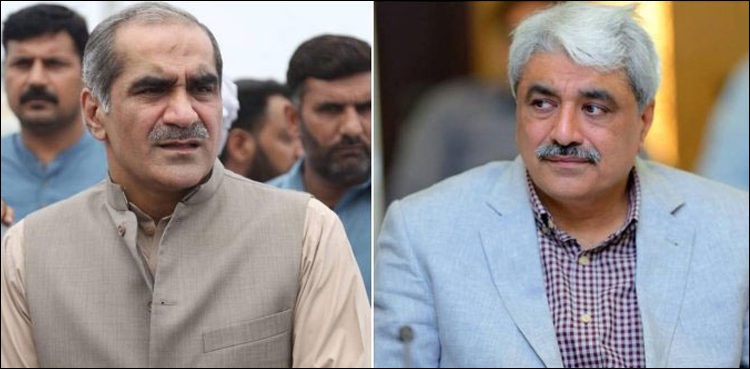
Khawaja brothers appear before NAB court in Paragon case

khawaja brothers paragon case accountability court

LAHORE: An accountability court in Lahore conducted the hearing of the Paragon Housing Society case against Khawaja brothers today, ARY News reported on Friday.

The accountability court’s judge Jawadul Hassan heard the corruption case against Khawaja Saad Rafique and Khawaja Salman Rafique. The Khawaja brothers appeared in the hearing.

A witness, Abdul Ghafoor Patwari, recorded his statement before the court during the hearing.

Later, the accountability court adjourned the hearing till October 14 and summoned more witnesses in the case in the next hearing.

Paragon Housing scam

According to NAB, Saad Rafique in collusion with his wife Ghazala Saad Rafique Butt, brother Salman Rafique, Qaiser Amin Butt and Nadeem Zia had launched a housing project named Air Avenue, which was later renamed to Paragon City (Pvt) Ltd).

Read: Paragon case: Khawaja Saad Rafique gets exemption from court appearance

Saad Rafique, his brother Salman Rafique, Nadeem Zia, Umar Zia, and Farhan Ali were named accused in accountability reference comprising of 17 volumes.

According to the reference, the Khawaja Saad Rafique, Khawaja Salman Rafique and Nadeem Zia owned 93.2 per cent shares in the Paragon Housing Society.

Besides, Saad Rafique acquired 40 kanals of land in his and his brother’s name, which he used to extend the project illegally and sold commercial plots worth billions of rupees.

It states that the former railway minister received monetary benefits to the tune of Rs58 million from the society whereas his brother Rs39 million.

The post Khawaja brothers appear before NAB court in Paragon case appeared first on ARY NEWS.


from ARY NEWS https://ift.tt/3l92HNw

SC upholds finality of settlements

The Supreme Court has ruled that no fresh financial claims can be raised after a final settlement has been reached, underscoring the sa...