Thursday, October 1, 2020

Trump starts ‘quarantine process’ after aide Hope Hicks tests positive for coronavirus

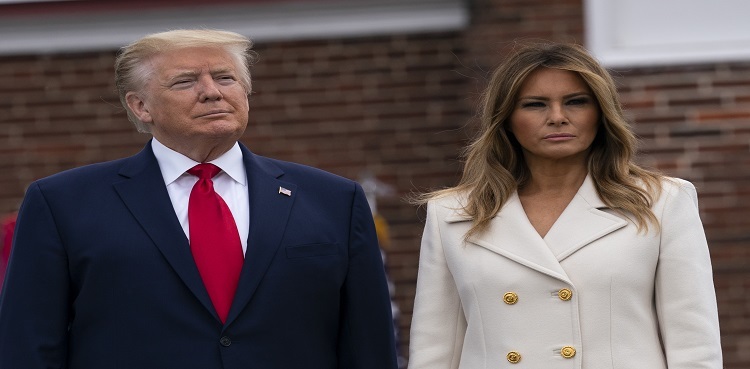
Donald Trump Melania Trump

WASHINGTON: US President Donald Trump said on Thursday he was beginning a quarantine process after Hope Hicks, a top adviser and trusted aide, tested positive for the coronavirus.

Hicks travels regularly with the president on Air Force One and, along with other senior aides, accompanied him to Ohio for the presidential debate on Tuesday and to Minnesota for a campaign event on Wednesday.

“Hope Hicks, who has been working so hard without even taking a small break, has just tested positive for Covid 19. Terrible! The First Lady and I are waiting for our test results. In the meantime, we will begin our quarantine process!” Trump said in a tweet.

Earlier, in an interview on Fox News, Trump said he and first lady Melania Trump had been tested for the virus and would know the results later on Thursday or Friday.

“I spend a lot of time with Hope, and so does the first lady. And she’s tremendous,” he said.

The president, who is tested regularly for COVID-19, has kept up a rigorous travel schedule across the country in recent weeks, holding rallies with thousands of people in the run-up to the Nov. 3 election, despite warnings from public health professionals against having events with large crowds.

Hicks’ positive test raises the possibility that others within Trump’s immediate circle and at the highest levels of the US government may have been exposed and have to quarantine as well.

Trump and his staff regularly do not wear masks, and Trump has denigrated people who wear them often. Health professionals say mask-wearing is one of the key things people can do to help prevent the spread of the virus.

At the White House, people who are around Trump, including some reporters, get tested on a regular basis.But the White House did away with daily temperature checks for everyone who enters the complex months ago, and people who are tested for the virus interact with others in the White House campus who are not.

The White House said in a statement that Trump “takes the health and safety of himself and everyone who works in support of him and the American people very seriously” and that it followed guidelines for limiting COVID-19 exposure to the greatest extent possible.

Trump said he was surprised that Hicks had tested positive.

“She knows there’s a risk, but she’s young,” he said on Fox News.

Hicks returned to the White House earlier this year after a stint in the private sector. She served previously as White House communications director and as a spokeswoman for Trump’s 2016 presidential campaign.

The post Trump starts ‘quarantine process’ after aide Hope Hicks tests positive for coronavirus appeared first on ARY NEWS.


from ARY NEWS https://ift.tt/2EPLfOG

Use of WhatsApp emojis to mock people can land you in jail

whatsapp emojis oman

If you are in Oman you must not indulge in using WhatsApp emojis to mock people lest it can get you in trouble.

Sending emojis of Omani and non-Omani characters in “sarcastic and inappropriate positions” through the messaging app constitutes a misdemeanor in the Omani Penal Code and could result in a sentence of imprisonment for a term not exceeding three years and a fine of no more than OMR (Omani Riyal) 5000.

WhatsApp video hacks your phone in 10 seconds?

“Lately, emojis of Omani and non-Omani characters have spread through the WhatsApp application for Omani and non-Omani personalities, in inappropriate positions or with sarcastic expressions,” the Times of Oman quoted a local lawyer as saying.

“Designing and sending, through WhatsApp, emojis of people’s pictures and placing them in a ridiculous form or in mocking terms, without the consent of the other party, is a violation and an encroachment on the private life of individuals.”

WhatsApp introduces animated stickers, dark mode for desktop

The lawyer said: “This act is a misdemeanor in the Omani Penal Code and results in a sentence of imprisonment for a period no less than one year and not exceeding three years, and a fine of no less than OMR 1000 and not more than OMR 5000 or one of these two penalties.”

The post Use of WhatsApp emojis to mock people can land you in jail appeared first on ARY NEWS.


from ARY NEWS https://ift.tt/3jpozE1

Pakistan’s V-shaped economic recovery

It may not be erroneous to postulate that the pandemic brought the best out of the Pakistan Tehreek-e-Insaf (PTI) government. While we cherish the luxury of getting back to our routines, we must acknowledge the prudent decision-making and coordination of federal and provincial authorities that intrepidly weathered the Covid-related storm. Pakistan enjoys an idiosyncratic head-start compared to others, which is steering the economy towards a swift recuperation.

Asad Umar, the Minister for Planning, shed light on Pakistan’s V-shaped economic recovery last month. Despite being laughed at by many, the concept is proving veracious in Pakistan’s case given the burgeoning remittances, current account surpluses, ameliorating foreign exchange (FX), and an orderly market-based rupee. According to the Business Confidence Survey of the State Bank of Pakistan (SBP), the Business Confidence Index (BCI) has exhibited a 33% improvement from 39 points in June to 52 points in August. The BCI previously saw a roughly 22% plunge from 49 points in February (pre-coronavirus) to 38 points in April.

However, the phenomenon of a V-shaped economic recovery is not novel. The revival of the American economy post the recessions of 1920-21 and 1953 are popular examples of a V-shaped recovery. This type of economic recouping is considered a best-case scenario in a recession-hit economy as it involves a steep escalation in economic indicators following a sharp plummet. In Pakistan’s case, the outbreak of the coronavirus accorded the SBP the space needed for an aggressive monetary easing despite being in an austere IMF programme. A whopping 625 bps cut pruned the policy rate to 7%, which Pakistan may never have caught sight of during the IMF programme if the pandemic hadn’t occurred.

The Current Account Balance (CAB) demonstrated a surplus for the second consecutive month in August. As reported by the SBP, the current account surpluses stood at $508 million and $297 million in July and August, respectively. In aggregate, the CAB illustrated an excess of $805 million in July-August fiscal year 2020 compared to $1214 million ($1.2 trillion) deficit in the same period last year. The mammoth surge is in the wake of towering remittances that soared in recent months owing to the compression of informal money markets and closure of international air travel. This has made compliance of formal banking routes obligatory for the expatriates to remit earnings back to Pakistan.

Pakistan is benefitting from the benign import prices of oil due to shallow demand. The import of services is also modest due to sparse international traveling. Simultaneously, the exporters are able to fetch exorbitant prices since the pandemic has disrupted global supply chains. The cumulative impact of these developments has resulted in a successive current account surplus. For the first time in Pakistan’s history, the CAB has endured three out of four consecutive months in the positive zone.

The transition in the exchange rate regime from a managed-float to a market-based rupee has also manifested to be propitious in this time of crisis. Not only has it assisted in making our exports compatible with those of Bangladesh, India, and other rivals in the international market, but it has also augmented the tumbling foreign exchange (FX) reserves. The spiralling trajectory of the FX reserves perpetuated despite the proliferation of the coronavirus in Pakistan since a stable currency attracts dollars from abroad in the form of Foreign Direct Investment (FDI) and Foreign Portfolio Investment (FPI). In consonance with SBP data, the total liquid FX reserves grew from $18.8 billion in February 2020 to $19.9 billion in August 2020.

A V-shaped, precipitous economic retrieval is evident in the case of Pakistan. The SBP has to persist with its pro-active role in line with the forehanded vision of an economically blossoming Pakistan. It is moot to expect a positive CAB in the future because the imports will pick up the pace once economies reclaim their pre-Covid economic standings. The current account surplus will only be short-lived if there isn’t an upturn in exports on robust fundamentals. Hence the government must ensure that it devises a strategy focused on perennially increasing exports.


from News Updates From Pakistan - Pakistani News - The Express Tribune https://ift.tt/3ifP2T3

Pakistan’s V-shaped economic recovery

It may not be erroneous to postulate that the pandemic brought the best out of the Pakistan Tehreek-e-Insaf (PTI) government. While we cherish the luxury of getting back to our routines, we must acknowledge the prudent decision-making and coordination of federal and provincial authorities that intrepidly weathered the Covid-related storm. Pakistan enjoys an idiosyncratic head-start compared to others, which is steering the economy towards a swift recuperation.

Asad Umar, the Minister for Planning, shed light on Pakistan’s V-shaped economic recovery last month. Despite being laughed at by many, the concept is proving veracious in Pakistan’s case given the burgeoning remittances, current account surpluses, ameliorating foreign exchange (FX), and an orderly market-based rupee. According to the Business Confidence Survey of the State Bank of Pakistan (SBP), the Business Confidence Index (BCI) has exhibited a 33% improvement from 39 points in June to 52 points in August. The BCI previously saw a roughly 22% plunge from 49 points in February (pre-coronavirus) to 38 points in April.

However, the phenomenon of a V-shaped economic recovery is not novel. The revival of the American economy post the recessions of 1920-21 and 1953 are popular examples of a V-shaped recovery. This type of economic recouping is considered a best-case scenario in a recession-hit economy as it involves a steep escalation in economic indicators following a sharp plummet. In Pakistan’s case, the outbreak of the coronavirus accorded the SBP the space needed for an aggressive monetary easing despite being in an austere IMF programme. A whopping 625 bps cut pruned the policy rate to 7%, which Pakistan may never have caught sight of during the IMF programme if the pandemic hadn’t occurred.

The Current Account Balance (CAB) demonstrated a surplus for the second consecutive month in August. As reported by the SBP, the current account surpluses stood at $508 million and $297 million in July and August, respectively. In aggregate, the CAB illustrated an excess of $805 million in July-August fiscal year 2020 compared to $1214 million ($1.2 trillion) deficit in the same period last year. The mammoth surge is in the wake of towering remittances that soared in recent months owing to the compression of informal money markets and closure of international air travel. This has made compliance of formal banking routes obligatory for the expatriates to remit earnings back to Pakistan.

Pakistan is benefitting from the benign import prices of oil due to shallow demand. The import of services is also modest due to sparse international traveling. Simultaneously, the exporters are able to fetch exorbitant prices since the pandemic has disrupted global supply chains. The cumulative impact of these developments has resulted in a successive current account surplus. For the first time in Pakistan’s history, the CAB has endured three out of four consecutive months in the positive zone.

The transition in the exchange rate regime from a managed-float to a market-based rupee has also manifested to be propitious in this time of crisis. Not only has it assisted in making our exports compatible with those of Bangladesh, India, and other rivals in the international market, but it has also augmented the tumbling foreign exchange (FX) reserves. The spiralling trajectory of the FX reserves perpetuated despite the proliferation of the coronavirus in Pakistan since a stable currency attracts dollars from abroad in the form of Foreign Direct Investment (FDI) and Foreign Portfolio Investment (FPI). In consonance with SBP data, the total liquid FX reserves grew from $18.8 billion in February 2020 to $19.9 billion in August 2020.

A V-shaped, precipitous economic retrieval is evident in the case of Pakistan. The SBP has to persist with its pro-active role in line with the forehanded vision of an economically blossoming Pakistan. It is moot to expect a positive CAB in the future because the imports will pick up the pace once economies reclaim their pre-Covid economic standings. The current account surplus will only be short-lived if there isn’t an upturn in exports on robust fundamentals. Hence the government must ensure that it devises a strategy focused on perennially increasing exports.


from News Updates From Pakistan - Pakistani News - The Express Tribune https://ift.tt/3ifP2T3

An autopsy of Pakistan’s industrial sector

Industrial performance is pivotal to ensure sustainable economic growth in the long-run. An engine of any economy, the industry supplies outputs not only to the local but also to foreign markets, which aids in stockpiling reserves to finance the imports of capital goods. Unfortunately, Pakistan has remained an industrially backward country since its creation. One of the largest contributors of jute to the world, Pakistan did not possess a single jute mill. Even today, the sector is heavily textile-reliant, with other key industries being engineering, agro-based, and chemical.

Despite employing roughly one-fifth of the labour-force, Pakistan’s manufacturing sector has displayed an appalling show over the years. Perennial reluctance to adopt a state of the art technology and consequent abysmal levels of productivity has been the core issue of our industries. Contrary to countries like India and China, Pakistan has experienced a series of boom-bust cycles due to a lack of industrial output diversity.

Pakistan’s governments have paid alarmingly low heed to address the industrial woes. Rarely did they develop viable strategies to incentivise investments in the research and development (R&D), which is why we witness a lack of concentration on the value-added items. This has adversely impacted the nature and quantum of our exports in the wake of sparse exposure to international markets. As a result, the exporters only managed an uninspiring competitive position compared to India, Bangladesh, and Vietnam.

Besides, there is an absence of impetus to invest in the industrial sector. Avenues like real-estate provide lucrative returns comparatively without demanding an exhaustive effort. This has transpired a shift from the industry to real-estate – particularly in plots – in the last decade or two. The most prominent case is that of Karachi, which has an overtly inflated real-estate due to the colossal investment of black money. The land is a haven to park ill-gotten wealth, considering the quality of laws and law enforcement prevailing in the country.

The present government inherited a yawning current account deficit (CAD) along with a deplorable foreign exchange position. This called for unpopular measures to shrink the CAD which the economic team managed by downsizing the imports substantially. However, this facile route is just a temporary fix. Pakistan cannot afford to restrict the imports of machinery and raw materials for an indefinite period, so it must go for a long haul. There has to be a concentrated effort to bolster the limping industrial sector.

A vibrant industry will improve our exports and contribute towards economic growth, which will have a positive trickle-down effect on human development. The government must ease the financing requirements if it wishes to encourage the setting up of an industrial plant. It can promote a research culture with sufficient funds to the relevant entities so that the industry savours the perks of innovation. This will ameliorate the quality and quantity of the goods we produce and make our exports compatible with others.

The incumbents need to prioritise the real economy over real estate. The construction package may boost economic activities, but it does not proffer a long-term solution to the deep-rooted economic imbalances. The renegotiations with the Independent Power Producers (IPPs) have to be accelerated. It should yield a downward revision in energy prices, which the industry badly needs. Pakistan also needs to come up with a robust solution to address the burgeoning circular debt. This has to be supplemented with propitious economic policies like a market-based exchange rate conducive to growth.

The crux of the matter is that a lack of innovation, modest production capacity, and exorbitant energy prices place a conundrum in front of the authorities about how to buttress the stumbling industrial sector. Now is the time to solve the perpetual structural issues to improve the macroeconomic scenario. This will assist in corroborating financial stability and economic prosperity in Pakistan.


from News Updates From Pakistan - Pakistani News - The Express Tribune https://ift.tt/2G5Sq5Q

An autopsy of Pakistan’s industrial sector

Industrial performance is pivotal to ensure sustainable economic growth in the long-run. An engine of any economy, the industry supplies outputs not only to the local but also to foreign markets, which aids in stockpiling reserves to finance the imports of capital goods. Unfortunately, Pakistan has remained an industrially backward country since its creation. One of the largest contributors of jute to the world, Pakistan did not possess a single jute mill. Even today, the sector is heavily textile-reliant, with other key industries being engineering, agro-based, and chemical.

Despite employing roughly one-fifth of the labour-force, Pakistan’s manufacturing sector has displayed an appalling show over the years. Perennial reluctance to adopt a state of the art technology and consequent abysmal levels of productivity has been the core issue of our industries. Contrary to countries like India and China, Pakistan has experienced a series of boom-bust cycles due to a lack of industrial output diversity.

Pakistan’s governments have paid alarmingly low heed to address the industrial woes. Rarely did they develop viable strategies to incentivise investments in the research and development (R&D), which is why we witness a lack of concentration on the value-added items. This has adversely impacted the nature and quantum of our exports in the wake of sparse exposure to international markets. As a result, the exporters only managed an uninspiring competitive position compared to India, Bangladesh, and Vietnam.

Besides, there is an absence of impetus to invest in the industrial sector. Avenues like real-estate provide lucrative returns comparatively without demanding an exhaustive effort. This has transpired a shift from the industry to real-estate – particularly in plots – in the last decade or two. The most prominent case is that of Karachi, which has an overtly inflated real-estate due to the colossal investment of black money. The land is a haven to park ill-gotten wealth, considering the quality of laws and law enforcement prevailing in the country.

The present government inherited a yawning current account deficit (CAD) along with a deplorable foreign exchange position. This called for unpopular measures to shrink the CAD which the economic team managed by downsizing the imports substantially. However, this facile route is just a temporary fix. Pakistan cannot afford to restrict the imports of machinery and raw materials for an indefinite period, so it must go for a long haul. There has to be a concentrated effort to bolster the limping industrial sector.

A vibrant industry will improve our exports and contribute towards economic growth, which will have a positive trickle-down effect on human development. The government must ease the financing requirements if it wishes to encourage the setting up of an industrial plant. It can promote a research culture with sufficient funds to the relevant entities so that the industry savours the perks of innovation. This will ameliorate the quality and quantity of the goods we produce and make our exports compatible with others.

The incumbents need to prioritise the real economy over real estate. The construction package may boost economic activities, but it does not proffer a long-term solution to the deep-rooted economic imbalances. The renegotiations with the Independent Power Producers (IPPs) have to be accelerated. It should yield a downward revision in energy prices, which the industry badly needs. Pakistan also needs to come up with a robust solution to address the burgeoning circular debt. This has to be supplemented with propitious economic policies like a market-based exchange rate conducive to growth.

The crux of the matter is that a lack of innovation, modest production capacity, and exorbitant energy prices place a conundrum in front of the authorities about how to buttress the stumbling industrial sector. Now is the time to solve the perpetual structural issues to improve the macroeconomic scenario. This will assist in corroborating financial stability and economic prosperity in Pakistan.


from News Updates From Pakistan - Pakistani News - The Express Tribune https://ift.tt/2G5Sq5Q

An open letter to the Punjab chief minister

Respected chief minister,

I am a Pakistani woman and a working mother who has a three-month-old daughter. You and I have never met or crossed paths in anyway. I have of course seen you on my screen and heard your speeches when you visit gatherings or inaugurations in Punjab. And I must say that I have always found you to be a gentleman who is humble and seems to focus more on his work than publicity; who is perhaps introverted but doesn’t let that hinder his very public role.

I understand that the previous weeks, following the attack and rape of a woman on the Lahore-Sialkot motorway, must have been almost as challenging for you, as they were for the public. Let me start by offering my sincere support for all those in your government who are working with you to try and transform this country into Riyasat-e-Madina.

There was a lot of emphasis laid upon my safety and security, with assurances that both will be provided when you take over as chief minister but this heninous and barbaric crime against my fellow sister has left me numb with shock. The last time I felt so terribly helpless and unsafe was after poor little Zainab was raped and killed in Kasur. There is widespread unease in the country once again, with people demanding that the rapists be hanged till death, just like they were back then. This time though, it is clearer than ever that the sense of security that I was living with was nothing more than a farce and that women are not safe anywhere in this country, not even at home.

Can you imagine the lack of trust, humiliation, misery, helplessness, and insecurity we feel as woman in this country? All while your CCPO, hired specifically for the protection of your citizens, chose to shift the blame onto the victim and to remind us that we do not live in France but in Pakistan.

Crimes like rape and sexual harassment occur everywhere in the world but unfortunately the sort of victim-blaming we see in Pakistan truly distinguishes us from any other country, as evidenced by the CCPO’s statements and echoed by other men even some women. As women, we do not deserve to live in constant fear. Our basic right to live is already affected largely but this fear that being out of the house translates to definite rape, especially if unaccompanied by a man, is new and absolutely gut wrenching. Especially since some of the cases coming out of Faislabad are rape crimes against women in their own homes and in some cases even by their own spouses. No one should have to keep looking over their shoulder constantly to ensure they will not be raped.

I have now started to feel like I have failed for raising my daughter in a country where females are looked at with pity, tinged with disgust. I feel like my daughter and I are not safe anywhere in Pakistan and that we will be blamed if crimes are committed against us. This is also the first time I want to leave the country and choose a safer future for my family. Despite having the means to move for several years, I had not fathomed that guaranteeing a good future would mean leaving the country.

Today as a Pakistani woman I don’t want lofty promises to be made to me. I am too tired to hear words that may only serve as a balm to the ears with no definite action behind them. All I want as a citizen of this country are the basic rights to life and safety, the very same ones promised to me in the constitution. I do not want to live under constant fear of being attacked in my house or on the roads in front of my children. I do not want to be scared my entire life just because I am a woman and because for some reason my safety depends on the very same men who keep proving time and time again that they are not worthy.

Respected chief minister, you must understand that I was not compelled to write this letter just because of the Lahore-Sialkot motorway rape survivor. I was compelled to write it for all the women that have been victims to and have survived rape. I was compelled to write for all those women who are equally tormented by the motorway rape and feel violated and unsafe. We as women are devastated, miserable, abandoned and feel like we are lesser beings. We also feel like we can be attacked by anyone, anywhere at any given time. Can you restore our shattered confidence and sense of peace again?


from News Updates From Pakistan - Pakistani News - The Express Tribune https://ift.tt/3mZJfF5

SC upholds finality of settlements

The Supreme Court has ruled that no fresh financial claims can be raised after a final settlement has been reached, underscoring the sa...